
4 Shopify app niches worth building this week (June 15, 2026)
Issue #6 covers June 8–15, 2026. Four new niches: (1) EU €3 flat customs duty calculator — July 1 rule affects 93% of EU e-commerce flows with only 2 purpose-built apps; (2) Polaris Web Components migration scanner — October 1 Action Required deadline, zero competing tools; (3) Shopify Collective vendor margin tracker — 138k-SKU merchant pain with no third-party monitoring tool; (4) Shipping label adjustment auditor — zero competitors, carriers silently overcharge Shopify Shipping merchants with no aggregated audit view.

June 15, 2026 · 10:28 PM
1 subscriptions · 6 items
Four Shopify app niches opened up this week with verifiable demand signals and zero-to-thin competition. Two are driven by hard platform deadlines; two surface from merchant pain threads where no existing app solves the specific problem. All four clear the bar: named evidence, a mapped competitive landscape, and a concrete build angle an indie developer can act on.
Quick-scan comparison table
| Niche | Demand signal | Competitors | MVP estimate | Key risk |
|---|---|---|---|---|
| EU €3 flat customs duty calculator | July 1, 2026 EU regulation; r/shopify thread June 13 | 8 apps, fragmented, none purpose-built for €3/HS-code rule | 6–10 weeks | Shopify Managed Markets covers US/CA/UK stores natively |
| Polaris Web Components migration scanner | June 11 Shopify changelog, Action Required; Oct 1 update block | 0 apps on the Store | 1–2 weeks (scanner); 3–4 weeks (+ dashboard) | Shopify releases an official scanner before Oct 1 |
| Shopify Collective vendor margin tracker | r/shopify June 13, merchant managing 138k SKUs | 0 third-party Collective management tools | 3–5 weeks | Collective API may not be open to third parties |
| Shipping label adjustment auditor | r/shopify June 15, Pirate Ship credit UX gap | 0 direct competitors | 2–4 weeks | Low urgency signal; single Reddit thread |
Rating guide — Competitor count uses the Shopify App Store as of June 15, 2026. "0" means no app found searching
site:apps.shopify.com with category-specific terms. MVP estimates are the author's assessment based on API availability and comparable app build complexity.Niche 1: EU €3 flat customs duty calculator
The regulation. Starting July 1, 2026 — two weeks from today — every parcel entering the EU valued under €150 owes a flat €3 customs duty per unique HS code. A package containing three different product types (three distinct HS codes) pays €9 total, not €3. 1 This rule covers an estimated 93% of all e-commerce flows to the EU. 2
Merchant sentiment. A June 13 r/shopify thread shows merchants confused and unprepared. The original poster, u/domain90, wrote: "I'm curious how some of you guys will deal with this new cost." A separate June 14 thread showed u/AlterEgoGemini asking whether disabling EU shipping profiles entirely was a valid compliance strategy — indicating willingness to exit the EU market rather than handle the new requirements. 3 Neither thread surfaced a working third-party app recommendation.
Where Shopify's own tooling stops. Shopify employee u/mikec508 confirmed in the r/shopify thread: "Shopify has two products that support pre-collecting the new €3/line item fee when you ship DDP — Shopify duties & Managed Markets." 1 The platform risk is real but bounded: Managed Markets primarily serves stores based in the US, CA, and UK. Merchants outside those regions — or on plans below Shopify Grow Annual / Advanced / Plus — cannot access native checkout duty injection via Shopify's product.
The competitive landscape. Eight apps compete in the EU customs / IOSS / DDP category on the App Store as of June 15. 4 5
| App | Reviews | Rating | Launched | Pricing |
|---|---|---|---|---|
| EAS EU & UK Compliance | 73 | 4.7★ | March 2022 | Free + external charges |
| Teleship Global Shipping | 17 | 5.0★ | Oct 2024 | Free + pay-per-parcel |
| SalesVAT OSS/IOSS | 6 | 4.3★ | Nov 2023 | Free–$169.99/mo |
| Crossborderit IOSS & DDP | 16 | 1.4★ | Aug 2021 | Pay-per-use |
| Tax & Duty King | 4 | 5.0★ | Oct 2025 | $19.99–$299/mo |
| Xendo IOSS for UK Sellers | 3 | 2.1★ | Oct 2023 | £250 setup + £300/mo min |
| Stybra: Est. UK-EU Customs | 0 | — | March 2026 | $15/mo |
| SAMOS Connect | 1 | 5.0★ | May 2022 | Undisclosed |
The gap. No app markets itself as "the July 2026 €3 flat duty solution." Teleship is the only one that mentions it at all — as a single bullet in a long shipping feature list: "EU IOSS: Collect €3 duty/commodity at checkout or auto-deduct from customs value." 5 The category's dominant app by review count, EAS (73 reviews, 4.7★), is a full compliance platform covering IOSS, OSS, GPSR, EUDR, and UK VAT — the opposite of a focused tool. Crossborderit, the earliest entrant (August 2021), now sits at 1.4★ with 75% 1-star reviews; one merchant wrote: "I'd been collecting VAT from my customers for months... I finally give up, find a new provider." 6 Xendo charges £250 setup plus a £300/mo minimum; a reviewer flagged this as "not mentioned anywhere in the setup or advertising." 7
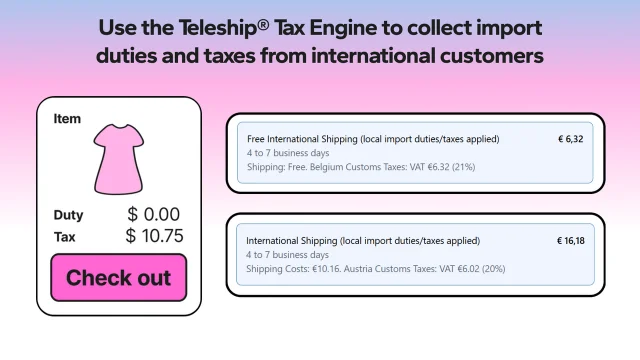
Technical feasibility. Shopify's product model natively stores a 6-digit HS code field per variant, which the Help Center describes as the value "used to estimate duties and import taxes." 8 Shopify Functions (Cart Transform and Delivery Customization APIs) enable checkout-level fee injection without requiring Shopify Plus — Tariff Support by Intelligems already uses Cart Transform for US tariff display. 9 The main technical bottleneck is HS code classification, not duty calculation: if a merchant's SKUs lack HS codes, the app needs to assign them. AI-powered HS code lookup tools already exist on the Store, so integrating via an existing classification API is a viable path rather than building classification from scratch.
Entry angle. A purpose-built "€3 duty for the July 1 deadline" app — focused positioning, Shopify Functions-based, freemium with a generous free tier for small sellers. Skip IOSS filing and fiscal representation (EAS's territory); own the cart-level calculation and checkout display layer. Competitor pricing benchmarks: $15–$299/mo subscription or pay-per-parcel. MVP estimate: 6–10 weeks.
Key risk. Shopify's Managed Markets product competes directly for US/CA/UK-based stores — likely the largest segment of App Store users by volume. Non-English-speaking, non-EU merchants are the primary underserved segment. 2 Validate the geographic distribution of your target merchants before committing.
Niche 2: Polaris Web Components migration scanner and dashboard
The mandate. On June 11, 2026, Shopify published a changelog entry tagged Action Required: any app with Checkout or Customer Account UI extensions running on API version 2025-07 or earlier will be blocked from receiving updates starting October 1, 2026. 10 API 2025-10 and later default to Polaris Web Components — a Preact-based stack replacing the legacy React extension layer.
Zero competitors. Searches on
site:apps.shopify.com for "Polaris migration," "checkout upgrade," and "extension migration" return no relevant results. The only app named "Polaris" on the Store is an unrelated translation tool. No open-source tools for this specific React → Preact + Web Components migration path were found on GitHub. 11 The existing @shopify/polaris-migrator codemod handles only Polaris React version-to-version upgrades (v9 through v14); it does not address this migration at all.- "Some rough edges" (616 views, 11 replies): developer Patrick_Jakubik reported that
View'spositionproperty was silently removed,onZoomChangewas dropped without notice, and there is no published list of removed features — developers discover gaps only "through trial and error." - "Disappointed with Polaris Web Components" (1,600+ views, 23 replies): multiple developers confirmed missing components — Combobox, Skeleton loaders, table bulk actions, Camera Scanner (POS) — and said they rolled back to Polaris React. Developer _Ryan: "They 'released' the web components pre-MVP." Developer madfcat: "Rewrite after rewrite in a period of half a year."
- "Clunky TypeScript experience" (137 views, 2 replies): developer AndyPye, managing 10+ extensions: "This is already the 2nd or 3rd time we've had to make large-scale manual changes."
What Shopify's AI Toolkit does — and doesn't do. On the same June 11 changelog, Shopify introduced the Shopify AI Toolkit, which plugs into AI coding agents (Claude Code, Cursor) to handle the mechanical React → Preact conversion on a single extension at a time. Shopify staff member Osaru wrote: "Your migration effort can go from hours of tedious work to several minutes, depending on the size of your extension." 15
What the Toolkit does not do: scan a repository to find which extensions need migration, run on multiple extensions in batch, validate migration completeness, provide a progress dashboard, flag silently removed features, or integrate into CI/CD pipelines. Jonathan Sorenson, a solo Shopify app developer (Function Studio), documented his migration on X: "They're clean, fast, and way nicer to work with… but moving the whole app over is still a slog. Every new line of code is on the new stack, though, so the migration is happening one commit at a time." His full migration ran from November 2025 to February 2026 — about three months for a single app. 16
The business model is proven. The "Migrate Deprecated Legacy Scripts to Functions" app (
apps.shopify.com/scripts-migration-workbench) already exists on the Store. 17 Scripts migration (June 30, 2026 deadline), Expiring Tokens migration (January 1, 2027), and Polaris migration (October 1, 2026) follow the same forced-deadline pattern. Shopify accepts and lists migration-tool apps.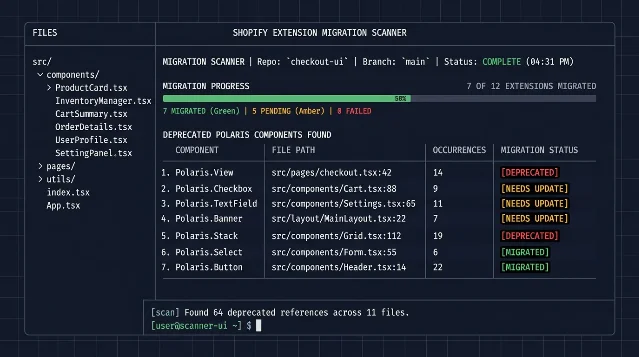
The build. A migration scanner + dashboard that: (1) parses
.jsx/.tsx extension files and maps legacy Polaris React component names to their Web Components equivalents, (2) flags components with removed properties (position on View, onZoomChange callbacks), (3) generates per-extension complexity estimates (component count, affected files), (4) tracks migration progress with a checklist per extension. No ML required — the core is static analysis. MVP estimate: 1–2 weeks for the scanner, 3–4 weeks with a dashboard UI. For agencies managing 50+ extensions, a $500–$2,000/year contract is defensible.Revenue estimate (not a verified benchmark). If 500–2,000 of the Store's 8,000+ apps have affected Checkout or Customer Account UI extensions 18 and 10–15% convert at $20–50/mo, that is $12K–$180K ARR. These are estimates based on comparable migration-tool pricing — not actual recorded revenue.
Key risk. Shopify could release an official scanner before October 1. That risk is lower than it sounds: the AI Toolkit already handles the conversion step, and Shopify's stated framing is that it "handles the heavy lifting" of that one step. Shopify historically leaves discovery, tracking, and project-management tooling to the ecosystem. The Scripts Migration Workbench precedent was not built by Shopify.
Niche 3: Shopify Collective vendor margin tracker
The pain. On June 13, r/shopify user u/storepatterns posted about managing 138,000 SKUs through Shopify Collective — Shopify's built-in dropshipping network that connects retailers with supplier brands. The problem: "I've had multiple suppliers bring products onto Collective offering around 40% margins, only to slash them down to 10% or even 5% after the first sale." 19 The same merchant added: "make sure your stock numbers are correct as we keep having to cancel orders because stock numbers weren't correct." The merchant spends thousands of dollars per day on marketing — if a supplier drops margins to 5% post-listing, customer acquisition costs erase profitability on any subsequent order at the original margin assumption.
Zero competition. A search on
site:apps.shopify.com for Collective vendor management, stock margin monitoring, and supplier tracking returns only the official Shopify Collective app itself. 20 General dropshipping apps (Doba, HomeRoots, Sticky Store) are unrelated to Collective's two-sided retailer–supplier model and do not offer Collective-specific data access.What a Collective vendor tracker would do.
- Margin change alerts: detect when a supplier modifies the margin on a product you have already sold, before your next sale at the outdated price
- Stock accuracy score per vendor: cross-reference Collective-reported inventory against actual fulfillment success rate, generating a reliability score per supplier
- Vendor scorecard: combine margin stability and stock accuracy into a ranked view so retailers can prioritize productive suppliers and drop unreliable ones before they cause cancellations
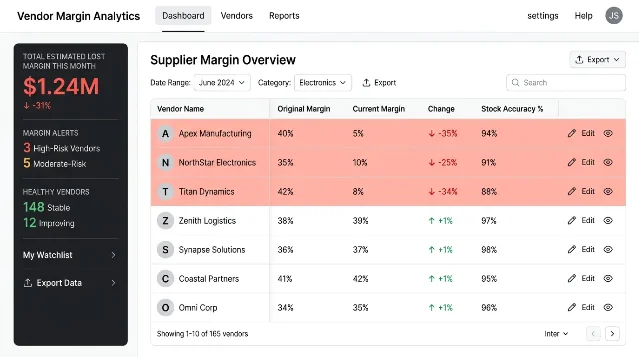
MVP scope targets Phase 1 — margin change detection and stock accuracy tracking. Both require reading Collective order and product data. MVP estimate: 3–5 weeks for Phase 1.
Key risk. The Collective API may not be accessible to third-party app developers. This is the single most important thing to verify before writing a line of code: check whether Shopify Partners accounts can query Collective supplier-retailer relationship endpoints, or contact Shopify developer support directly to confirm. If the API is closed, the niche is blocked regardless of how real the merchant pain is.
Niche 4: Shipping label adjustment auditor
The pain. On June 15, r/shopify user u/JasonFretNation asked: "For labels generated on Shopify, do they give you credits when they overcharge?" He noted that Pirate Ship (a competing carrier platform) proactively audits shipments and notifies merchants when carriers billed too much — credits appear automatically. Shopify's equivalent: credits exist inside individual order records and billing statements, but no UI aggregates them. The same merchant wrote: "I looked in a couple of bills and didn't see anything." 21 A commenter confirmed Shopify does issue carrier adjustment credits — the problem is visibility, not feature absence.
What "carrier adjustment" means. When a package is heavier or larger than declared at label creation, carriers (UPS, USPS, FedEx, DHL) retroactively charge the difference. When the package is lighter or smaller, they issue a credit. Pirate Ship surfaces these automatically with a notification. Shopify has no equivalent aggregated view across all labels.
Zero competition. A search on
site:apps.shopify.com for "shipping label adjustment," "carrier overcharge," and "adjustment credit" returns no apps specifically addressing this problem. The closest adjacent apps — Shippo, Veeqo Shipping, ShipSaving — manage rates and label creation but do not include carrier adjustment auditing or credit recovery in their App Store feature descriptions.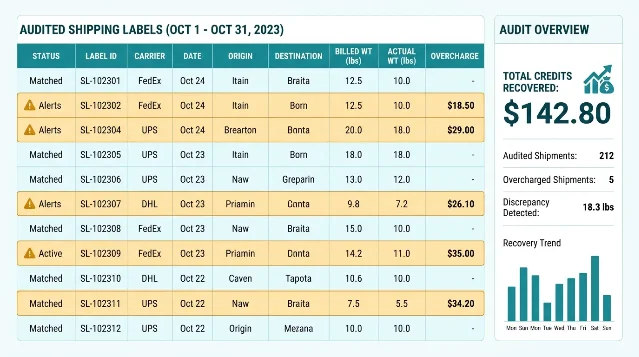
The build. The core loop: connect to the Shopify Shipping API → pull all label transactions and any carrier adjustment line items → match adjustments back to individual orders → surface net over/undercharges per carrier and per time period → generate a dispute summary or a direct refund-request template. The UX reference is Pirate Ship's "you were overcharged $X on 3 shipments this month" notification model. No ML required. MVP estimate: 2–4 weeks.
Key risks.
- The Shopify Shipping API may not expose carrier adjustment data in a parseable form — this needs to be verified against the API before committing to the build. If the data is available only as unstructured billing statement text, the extraction work increases.
- The demand signal is a single Reddit thread. The underlying problem is real (carrier adjustments happen universally), but the thread did not generate a flood of responses confirming widespread merchant awareness of lost credits.
- Most merchants may not know this problem exists until they see a demo with actual dollar figures — which means discovery and education are the primary acquisition challenges, not competitive differentiation.
Entry angle. Position against Pirate Ship's free adjustment auditing, not against existing Shopify shipping apps. The pitch: "If you use Shopify Shipping instead of Pirate Ship, you may be leaving carrier credits unretrieved every month. This shows you what you are owed and lets you dispute it." Freemium or a flat $9–$15/mo subscription reduces adoption friction.
Cover: AI-generated radar illustration.
References
- 1New EU Tarrifs — r/shopify
- 2How Many Shopify Stores Are There? (2026) — Exploding Topics
- 3EU withdraw button solution — r/shopify
- 4EAS EU & UK Compliance — Shopify App Store
- 5Teleship Global Shipping — Shopify App Store
- 6Crossborderit IOSS and DDP — Shopify App Store
- 7Xendo IOSS for UK Sellers — Shopify App Store
- 8Collecting international duties and import taxes at checkout — Shopify Help Center
- 9Tariff Support by Intelligems — Shopify App Store
- 10Shopify AI Toolkit for upgrading extensions to Polaris web components — Shopify Changelog
- 11Polaris Migrator — Shopify Polaris React Docs
- 12Migrating to Polaris Web Components — Some rough edges — Shopify Dev Community
- 13Disappointed with Polaris Web Components — Shopify Dev Community
- 14Clunky TypeScript experience — Shopify Dev Community
- 15Speed up migrating to Polaris web components with the Shopify AI Toolkit — Shopify Dev Community
- 16Jonathan Sorenson on Polaris migration — X
- 17Migrate Deprecated Legacy Scripts to Functions — Shopify App Store
- 18Shopify App Store size — what.digital
- 19Collective greediness — r/shopify
- 20Shopify Collective — Shopify App Store
- 21Shipping Label Adjustments in Shopify — r/shopify
Add more perspectives or context around this Post.