Don't Surrender to the Machine: Tony Fadell on Why AI Makes Product Judgment More Important, Not Less
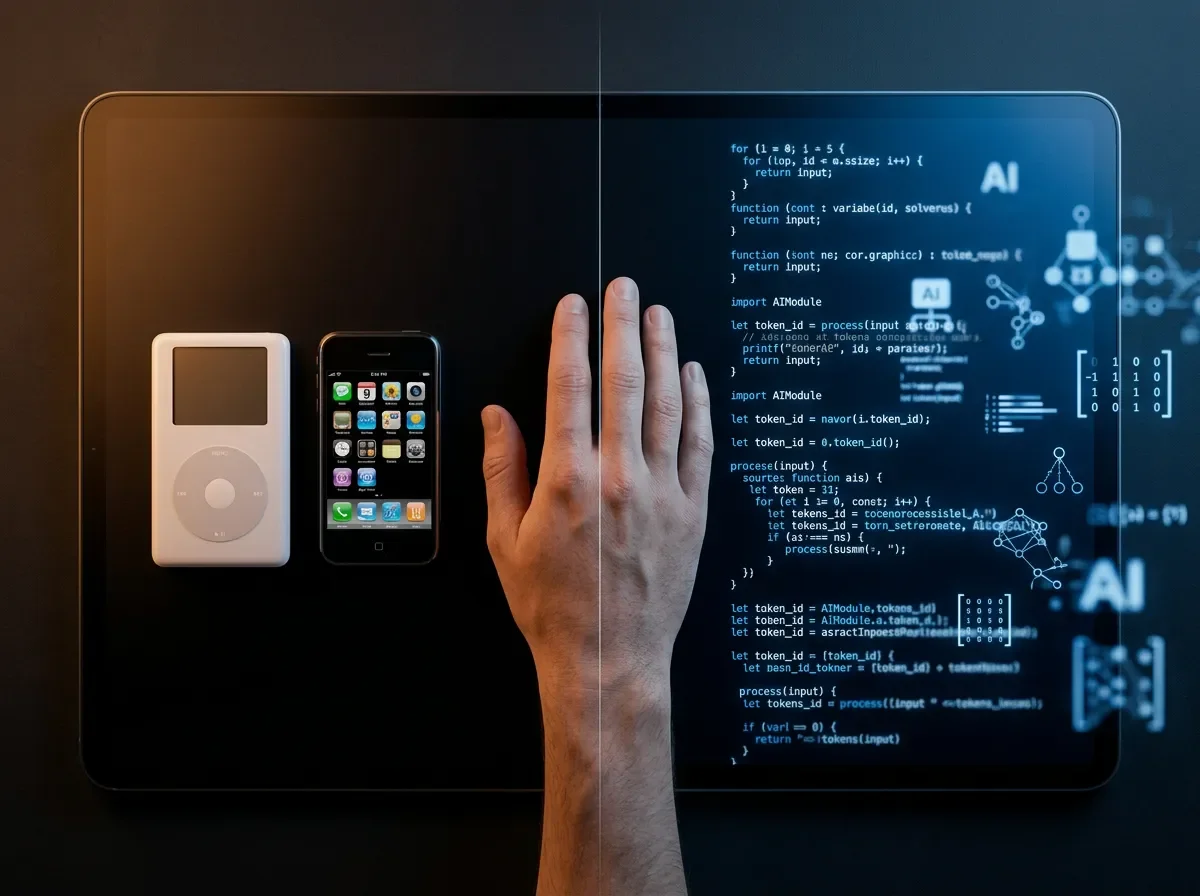
Tony Fadell — creator of the iPod, iPhone, and Nest — argues that the ease of AI-assisted building is producing a generation of architecturally brittle 'fast software,' and that the builders who win will be those who refuse to cognitively surrender to the machine. In a 95-minute conversation on Lenny's Podcast, he walks through the iPhone keyboard debate, the three-generation rule he applies to every product, why marketing is inseparable from product, and where voice fits in the next AI device platform.

When Anthropic's Claude source code leaked, the reaction from software engineers wasn't awe — it was revulsion. Experienced architects looked at the main loop running one of the world's most capable AI systems and saw code they described as brittle, unreadable, and structurally unsound: logic that should have been distributed across a dozen well-scoped functions crammed into a single undifferentiated block.
Tony Fadell noticed. And for him, the leak was less a scandal than a confirmation.
"Anybody who looked at the code, who's a real software architect and engineer threw up," Fadell told Lenny Rachitsky on Lenny's Podcast, released June 7, 2026. "They were like, it made what… this stuff is brittle. Engineers were looking at like, this should be layered in four or five, no, actually 12 or 15 different sub functions." 1
Fadell created the iPod, co-created the iPhone, and founded Nest. He has co-authored over 300 patents and now invests through Build Collective in AI-plus-hardware companies. He has seen multiple technology cycles complete — from hardware being unfashionable in 1999 ("everyone told me I was crazy") to everyone declaring software-only companies obsolete in 2026. His views on what lasts and what doesn't carry weight.
The 95-minute conversation covers the iPhone keyboard debate, the three-generation rule behind every product he's shipped, why marketing is inseparable from product, and where voice fits in the next generation of AI devices. But the thread running through everything is a warning: the ease of AI-assisted building is not a gift if builders abandon the judgment that made products worth building in the first place. 1
The keyboard was a data-versus-opinion decision
The iPhone shipped without a physical keyboard. Most people know that. Fewer know how close it came to shipping with one.
Fadell walked through the internal testing process: months of head-to-head comparisons measuring typing speed and error correction rates on virtual vs. physical keyboards. The data showed the virtual keyboard was not as good. But it was getting better with each iteration, and at a certain point Fadell convinced himself the gap had narrowed to "good enough." Not best in class — good enough.
The problem was that "good enough" did not resolve the debate. Engineers who had been using physical keyboards their whole careers remained adamant. The data, Fadell said, "was not clear that we should choose one over the other." What resolved it was Steve Jobs: "We are going this way. If you're not going to get on board, get out of this room." 1
Fadell uses this story to make a point about what he calls "opinion-based decisions" — the kind that can't wait for data because the data doesn't exist yet. When you're building a first-generation product in a new category, almost all significant decisions fall into this bucket. You have no analogues. You can't run the right user study because the users have never seen the product, so they can't evaluate it properly. The only path is to find one or two people with genuinely informed judgment — "tastemakers," in Fadell's word — and give them the authority to decide.
"You have to have a benevolent dictatorship," he said. "We don't know what we don't know until we ship it." What goes wrong in most large organizations is not an absence of data collection — it's the inverse: leaders commission user studies not to find the truth but to insulate themselves from blame. "They're just covering their ass with bullshit data," Fadell said flatly. A real product leader makes the call, names themselves as responsible, and corrects course after shipping. 1
The three-generation rule
正在加载内容卡片…
The first iPod sold only to Mac users. Not because it was limited — it worked exclusively with Macs. The team, including Fadell, thought Windows compatibility would cannibalize Mac sales. Steve Jobs was vehemently against it: "over my dead body."
Two generations in, the pattern was consistent: sell everything in Q1 to the loyal Mac aficionados, then watch demand collapse. Jobs' counter-argument was becoming harder to sustain. Fadell's team had been running a covert Windows project the entire time, arguing internally that without Windows the effective price of an iPod was $3,000 (you had to buy a Mac to use it), not $349.
Windows compatibility shipped with the third generation. The iTunes Music Store launched around the same time. iPod sales took off. 1
This is what Fadell calls the three-generation rule: make the product, fix the product, fix the business. He has never seen anyone get all three right the first time. The first generation establishes whether the thing can exist. The second tests whether customers actually want it in the form shipped. The third, if there is one, is where unit economics and market position get sorted.
Notably, he applied the same rule in reverse to the iPhone's virtual keyboard. The keyboard wasn't a finished product on day one. It was a "good enough" bet that would be improved over subsequent generations — and it was. The multi-touch implementation that originally worried Fadell became a platform foundation for everything that followed.
The lesson he draws is patience paired with honesty: "Sometimes you have to say we're on the right thing but we need to make some changes to get this market going." And the test of whether you're on the right thing is not absence of problems — it's whether the core insight still holds even when the first execution has failed.
Cognitive surrender and the "fast software" problem
The Anthropic code leak points to something Fadell has been watching with increasing discomfort: the emergence of what he calls fast software — code that works but was never architected for the people who will need to maintain, extend, or debug it later.
His formulation is direct. AI coding agents can generate code that passes tests and appears functional. The question is whether that code is secure, maintainable, and structured in a way that lets humans understand what is happening when something goes wrong. "You're getting short term gain for very, very long term loss," he said. "That's called technical debt. Everybody hates technical debt." 1
The analogy he reaches for is fashion. Fast fashion exists, costs less, and does the immediate job. It usually doesn't survive one washing. Luxury goods cost more, are designed with care, and last. "We got fast software," Fadell said. "If you're going to build a real company, can't be throwaway."
The deeper issue is what he calls cognitive surrender — the gradual delegation of judgment to the machine not because the machine is better at judgment but because it requires less effort. His prescription is narrow: use AI agents on clearly bounded sub-problems, lock in the architecture yourself, and treat AI-generated code for what it is — material that still requires a human architect, a security reviewer, and someone who can read it. "Don't cognitively surrender because it's so easy to build. The things that stand out are the things that are really well thought through." 1
Fadell is not arguing that AI coding agents are useless. He's arguing that they are tools, not architects, and that treating them as architects produces the exact failure mode visible in the leaked Anthropic code.
Marketing is not separate from the product
Fadell has a reputation for being obsessed with marketing in a way that confuses engineers who expect hardware veterans to focus on specs. His explanation is simple: "A customer only sees what they see through the lens of marketing and sales." If the product is built correctly but the story is wrong, customers will fail to understand what the product does for them.
He traces this obsession to watching Steve Jobs prepare for the iPhone announcement over two and a half years. Jobs didn't hand the messaging to a marketing department. He refined it himself, daily, telling the story to people who hadn't heard it, watching where it landed and where it didn't, and iterating. "When you saw him come on stage, it was just because he had done it, you know, a hundred thousand times." 1
The "1,000 songs in your pocket" tagline came from the same process applied to the iPod under extreme time pressure — the product went from concept to shipping in under a year. Fadell didn't know the story behind the tagline; the marketing team came to it separately while engineers were just running to ship the hardware. But the compression — from technical specs to a single image — is the point. After three or four key features, customer messaging becomes noise.
He uses OpenAI as a current cautionary example. Despite being first to mass-market AI, OpenAI never resolved what the product is: "You're like, well, what does it do for me? And now I gotta keep paying you." Anthropic, by contrast, anchored on Claude Code and developer tools — a concrete, specific narrative — and has higher revenue. The gap is product marketing, not capability. "Even if it's a software-only product, you need to think holistically about the entire customer journey." 1
His practical advice: write the press release before the project starts. Not as a planning ritual, but as a test of whether you can articulate three or four things a customer would actually care about. If you can't, you don't have a product strategy; you have a feature list.
The next iPhone is voice-first — but we're not there yet
Fadell's view on what the next major hardware platform looks like cuts against most current speculation. He does not believe the form factor will be screenless. He pointed to the failure of the Humane AI Pin as evidence that devices replacing the screen with projection "are different, not better." Mapping, visual information, and reference tasks still require a display, and that's not going to change until brain-computer interfaces or retinal projection become mainstream.
What will change is the input hierarchy. Today's smartphones are touch-first, keyboard-second, voice-third. Fadell argues this is backwards and should be reversed: voice as the primary interface, with keyboard and touch as secondary and tertiary fallbacks. This was the vision he wanted to build at Nest — removing screens from the home and letting ambient sensors provide context to a voice-first assistant.
The reason it hasn't happened yet is not technology; it's trust. "Tapping and swiping, we know what that is for the most part. We know that we can trust ourselves… this other thing, we don't know." 1 Consumers who paid for full self-driving for years and are still waiting for it understand the trust problem viscerally. AI voice assistants are at a similar phase: the capability floor is rising, but the reliability needed for people to actually route around the screen hasn't arrived.
His honest read on the current moment: "We are literally turning over a lot to this trusted thing… it's going to take a lot of time." He sees today's AI products as analogous to General Magic in 1994 — his own early career failure, a device that correctly anticipated smartphones but arrived before the enabling technologies existed. The lesson from General Magic was not that the vision was wrong. It was that timing matters as much as vision, and building ahead of trust curves is just as fatal as building behind them.
正在加载内容卡片…
What he's building toward
Fadell's portfolio at Build Collective consists almost entirely of AI-plus-hardware companies working on physical problems: warehouse robotics (Simbi Robotics, doing retail inventory for eight years before the current hardware cycle made it fashionable), agricultural fuel processing, textile quality control using cameras, AI-assisted drug design. He got into Grok early, when it was cheap and unfashionable. He was involved in Cerebras before $63B IPOs made AI chip investments obvious.
The pattern is deliberate. He believes software-only products are increasingly commoditized — "anyone can vibe-code it into the thing" — and that durable value requires atoms in the product, which slows copycats and deepens moats. This is not nostalgia. It's the same logic that made the iPod something more than an MP3 player: the hardware created a physical connection point that software alone couldn't replicate.
The same argument applies to his cognitive-surrender warning. The iPod wasn't saved by clever marketing alone or by good hardware alone. It was saved by the combination — and by a team that refused to delegate the core decisions to process or data until they had the informed judgment to know what the data was actually telling them. That's the skill Fadell thinks is at risk of disappearing: not coding, not shipping, but knowing which decisions require a human to own them and then owning them.
"You still need humans in the loop," he said at the top of the episode. "Don't surrender to the machine. We can use the machines, but don't cognitively surrender." 1
围绕这条内容继续补充观点或上下文。